An electron lighthouse: current in a chip, without plugging in a single battery
Physicists from the University of Michigan have circulated an electric current in a piece of semiconductor without applying any voltage. No battery, no generator, nothing. Just two laser beams of different colors, crossed at the right spot. By rotating the polarization of the light, the researchers also rotate the current in the material, like the beam of a lighthouse sweeping the night. The article was published on July 28 in Physical Review Letters.
I’ll warn you right away: this won’t charge your phone. But the idea is bold enough to deserve five minutes.
The problem is that an electron goes nowhere by itself
All electronics rely on a rather rustic principle. Want to send electrons from point A to point B? You apply a voltage between the two, which creates an electric field that pushes them. It’s effective, it has worked forever, and it’s as subtle as blowing on marbles to make them roll.
The issue is that this electric field comes with its baggage. You need electrodes, a power supply, and wiring. On top of that, the system heats up. Since the 1990s, theorists have been looking for another way: to do without voltage and ask light directly to do the job.
One of them is John Sipe from the University of Toronto. He had predicted this effect theoretically. Thirty years later, a team achieved it in the lab.
Two paths to the same place
The mechanism relies on quantum interference. A particle can reach the same state through multiple paths. These possibilities then overlap like two waves: depending on how they meet, they reinforce or cancel each other out.
Specifically, the material is illuminated with two colors at the same time. An electron can gain the same amount of energy in two ways: by absorbing a green photon at 520 nanometers, or two infrared photons at 1040 nanometers. Two different additions, same total. At the quantum scale, the electron does not choose a path. Both possibilities coexist and interfere.
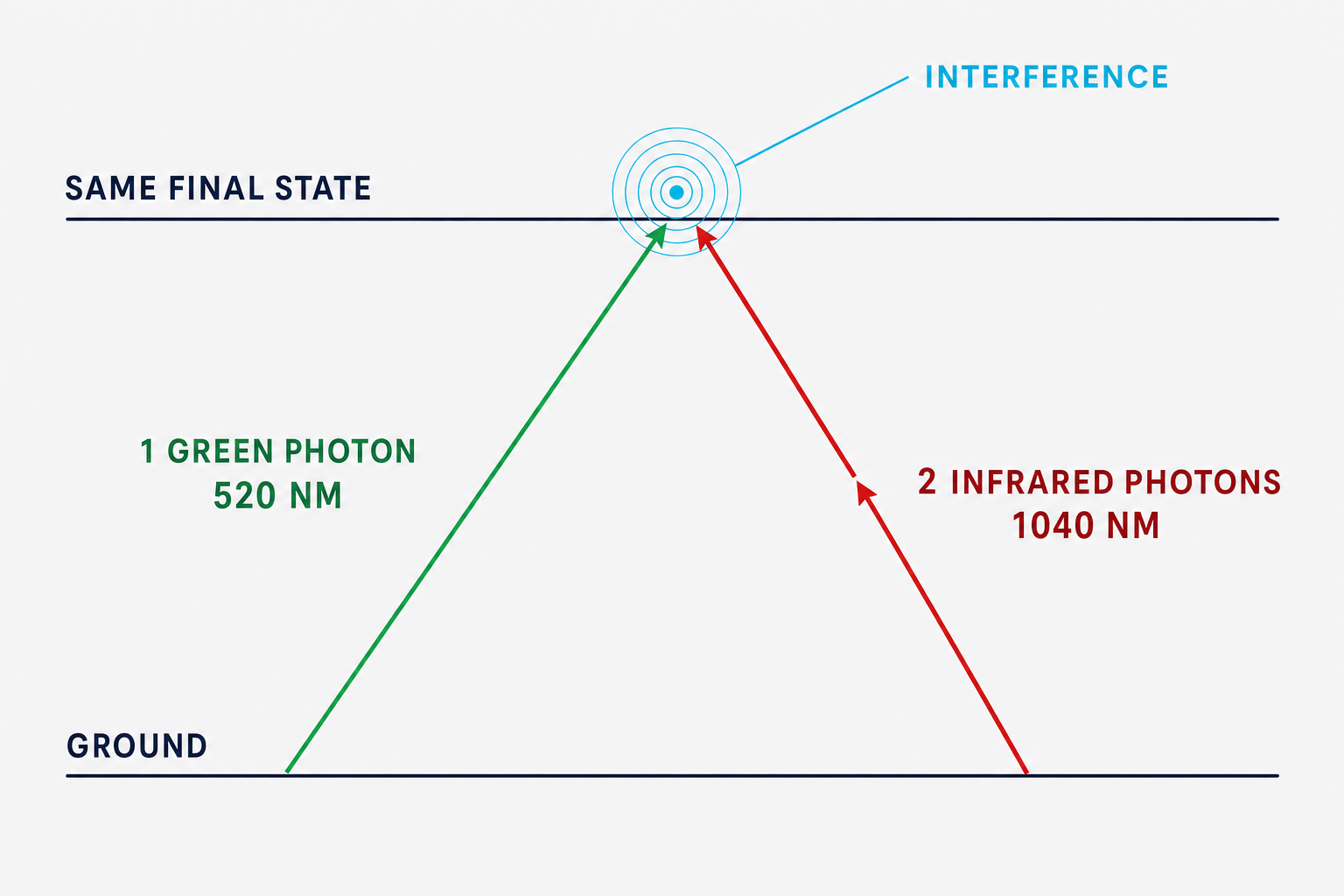
One green photon or two infrared ones. Same destination, and the electron takes both paths.
This is where it gets interesting. For electrons heading in a specific direction, the two paths reinforce each other. In other directions, they cancel out. Instead of going in all directions, the electrons therefore move more in the same direction. This produces a current, without voltage to push them.
The lighthouse
The next part gives the experiment its name. The direction of the current depends on the polarization of the light, that is, the orientation in which the light wave oscillates. Imagine a rope that you shake up and down rather than side to side.
The device features two pairs of perpendicular electrodes, arranged in a cross around the material. When the researchers rotate the polarization by 90 degrees, the current disappears on one pair and reappears on the other. The flow of electrons has rotated a quarter turn in the chip, with no part moving.
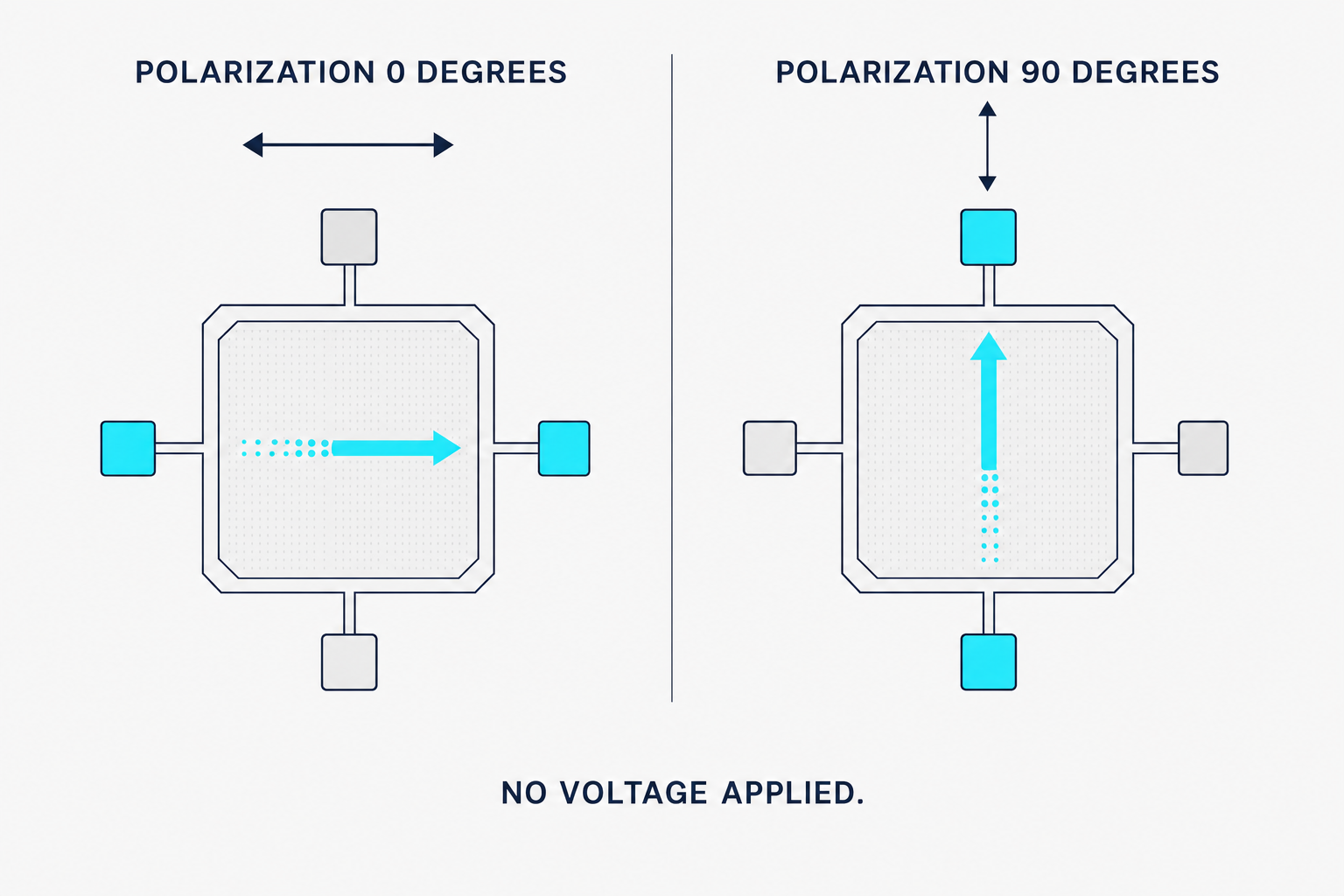
You turn the light, the current changes output. No switch to mess with.
A detail I particularly like: the electrons travel in a ballistic regime. This means they traverse the material in one go, with very few collisions, instead of slowly scattering like in a regular copper wire. It’s the difference between running in an empty room and crossing the subway at 6 PM.
The setup, and it’s beautiful
The material used is not silicon, but aluminum gallium arsenide, specifically Al0.28Ga0.72As. Its bandgap has been tuned to match the right energies. This bandgap is the energy gap that an electron must overcome before it can participate in electrical conduction. The laser pulses last about 85 femtoseconds. One femtosecond is one millionth of a billionth of a second. At the same scale, one second would last about thirty million years.
The source is a fiber laser doped with erbium and locked modes. In other words, its different light modes are synchronized to produce very short pulses. The team also tested a more twisted case: two photons at 1040 nanometers against three photons at 1560 nanometers. The principle remains the same, but the mechanism requires more photons. It then concentrates the electrons in a narrower range of directions. The beam of the spotlight becomes sharper.
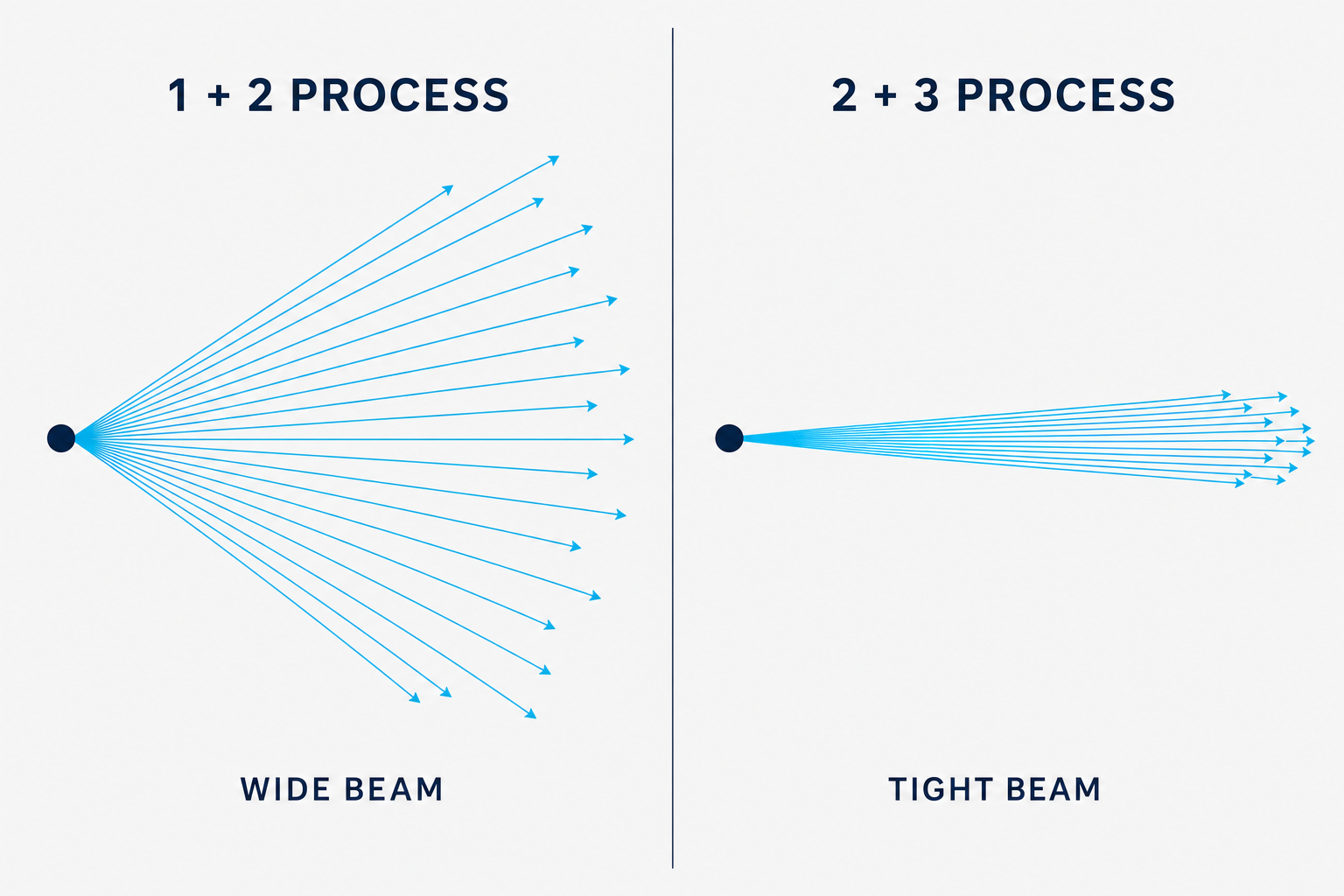
On the left the watering can, on the right the water gun. Same flow, different aim.
A figure gives the measure of the precision needed: the current reacts to variations in optical path of a few tens of nanometers. The optical path corresponds to the distance traveled by light, taking into account the medium it passes through. To stabilize this path, the researchers reduced the frequency noise of the laser, thus its small parasitic fluctuations, from several hundred kilohertz to about 1 hertz. One could say that you don't sneeze in the room.
Another subtlety: the electrical contacts are ohmic and not Schottky. An ohmic contact allows current to pass without creating an electrical barrier that favors it in one direction only. A Schottky contact, on the other hand, forms such a barrier and can generate a parasitic field. No voltage is applied during the measurement. This was essential: the slightest external electric field could have produced a current and ruined the demonstration. When you claim to create current without voltage, it's better not to hide one under the rug.
So, what does this change for you?
Legitimate question. Honest answer: nothing this year, nor next year. This research is still in the testing phase, in a laboratory. We are far from a product sold in stores. But it could, one day, change three things in a normal home.
1. Your internet box could translate less
Today, fiber carries your videos, your emails, and your backups in the form of light. But your box, your phone, and your computer operate with electricity. A component must therefore convert light into electrical current, and sometimes do the reverse. Each conversion takes a bit of time, consumes energy, and produces heat.
With this process, light creates current and gives it a direction directly. The conversion and routing thus happen in one step instead of two. In your box, the difference would probably be invisible. But the data centers that run your videos, emails, and backups perform these operations on a very large scale. They also have to dissipate the heat produced. This is especially where this process could become useful.
2. Devices that see what your eye cannot see
This is the easiest use to imagine, and it already partially exists. This research uses polarization, which is the direction in which light is oriented. The team wants to create a detector capable of directly reading this information. Your eye and your phone's camera do not capture it directly.
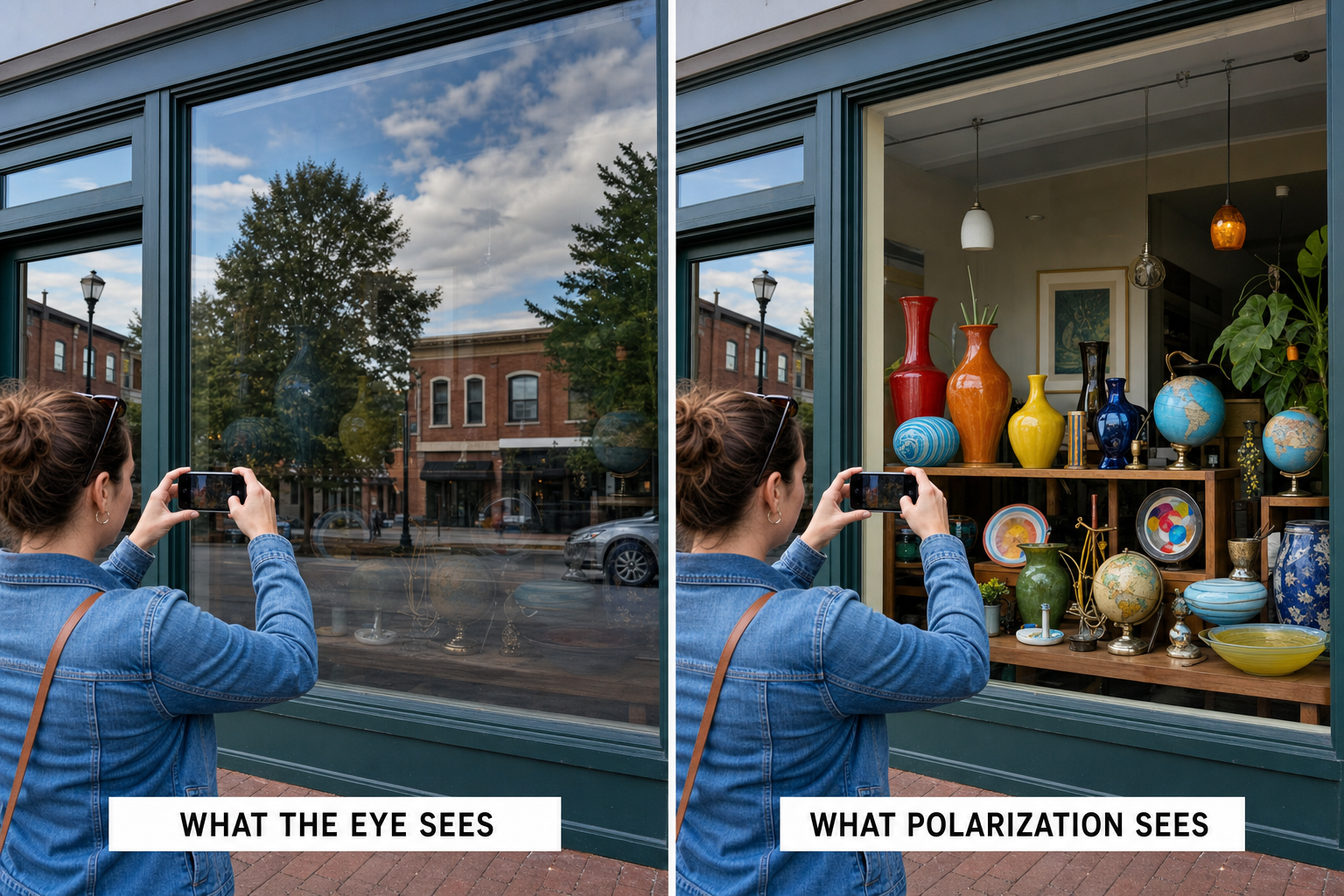
Same showcase, same time. On the right, we just asked the light to behave properly.
A sensor sensitive to polarization can see better despite the reflections of a glass or a puddle. It can also detect stresses inside a piece of glass or plastic. They are invisible to the naked eye but can indicate a crack. The sensor can even distinguish two materials that have the same color. Industrial cameras already use this information to control packaging or screens at the output of a factory. It can also help an autonomous car when the low sun turns the road into a mirror.
This research could allow reading polarization directly, without stacking filters in front of the sensor. In everyday life, this could one day provide a photo of a showcase without the reflection of your head in the middle. It's not vital, but your floating head won't be missed by anyone.
3. Wirelessly control what is too small to be wired
This third use is the most distant. Usually, to control an electric current, you need to add connections. The smaller a component is, the more these wires take up space and produce heat. Here, a light beam triggers the current remotely, without direct contact. This could allow controlling components that are too small to be easily wired.
No one knows yet if this idea will lead to a usable product. For now, it mainly shows that contactless control is possible. It's a research avenue, not a promise with a delivery date.
And when is it coming?
Honestly, in ten years, in twenty years, or never. Many lab discoveries do not become any product. This one may very well meet the same fate.
The laser, however, reminds us that a discovery without an obvious use can eventually become commonplace. When it appeared in 1960, no one really knew what to do with it. It was described as a solution in search of a problem. Today, it reads the barcode of your groceries, is used to operate on eyes, and transports this article to your screen via fiber. The thing deemed useless in 1960 now intervenes in your life about ten times a day.
An electron beacon in a Michigan lab seems very far from your kitchen. It may remain so. The example of the laser proves nothing, but it explains why researchers continue to work on ideas whose utility is not yet visible.
Personally, what I like here is the reversal. We spent fifty years converting electricity into light and light into electricity, each time with an intermediary to push the charges. Here, light does not just create mobile electrons. It also tells them where to go. It's not really a component yet. It's mainly proof that we can hold the steering wheel differently.
The first author, Yiming Gong, has defended his thesis and now works as a machine learning scientist in Chicago. We wish him that his models converge as well as his photons. The article is co-signed by Kai Wang, a former postdoctoral researcher from the lab who has become a professor at Sun Yat-Sen University, and Steven Cundiff. To delve deeper into the subject, Laser Focus World details the optical setup much better than I do. ScienceDaily offers a shorter summary.
No comments yet.